If Your Scoliosis Has Never Been Properly Evaluated, Now Is the Right Time

Scoliosis in adults is consistently underdiagnosed and undertreated, not because effective care does not exist, but because the condition is so frequently misattributed to generic back pain, never properly investigated, or simply written off as an unavoidable consequence of aging. The chronic pain and functional limitations that come with unmanaged scoliosis are real. They are also, in many cases, addressable.

At Gerling Spine Care and Research Institute, patients at our West Orange location receive the thorough diagnostic evaluation and individualized treatment that scoliosis genuinely requires, from a team with deep experience across its full range of presentations and severity levels. Contact our West Orange office today to schedule a scoliosis evaluation and find the right path forward.

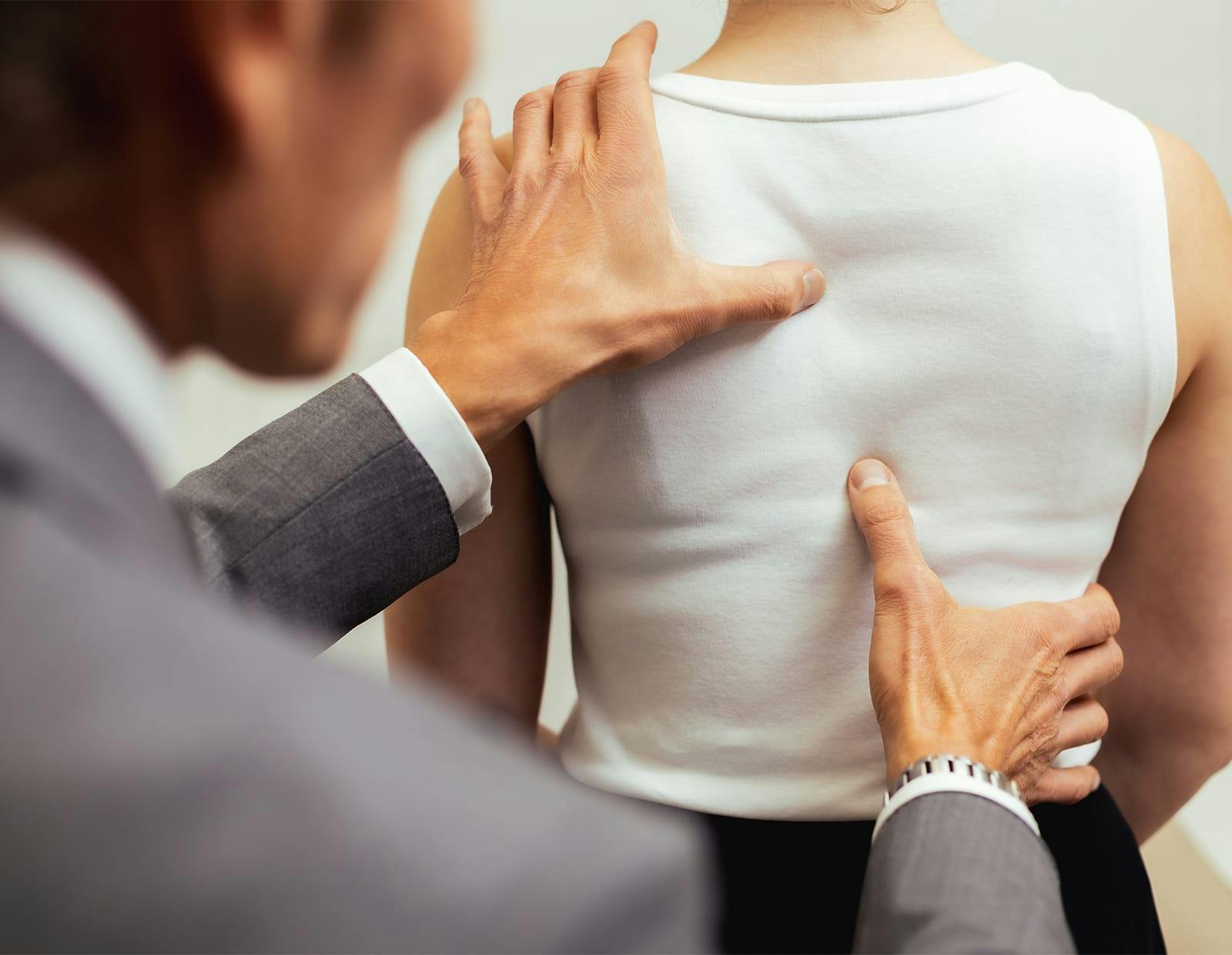
Dr. Michael Gerling examining a patient's back

What Is Scoliosis?

Scoliosis is an abnormal lateral curvature of the spine measuring 10 degrees or more on imaging. Rather than following a straight vertical line from top to bottom, the spine bends sideways, often into a C or S shape, and in many cases also rotates, producing the visible asymmetries patients sometimes notice in shoulder height, hip level, or the contour of the rib cage and flank.

Types of Scoliosis in Adults

The type of scoliosis a patient has shapes the entire approach to managing it: the causes, the likelihood of progression, and the treatments most likely to help all differ meaningfully between types.

Adolescent Idiopathic Scoliosis

Adolescent idiopathic scoliosis develops during skeletal growth without a clearly identified cause. Adults with this form may have carried a curve since childhood, diagnosed or not, that remained stable for years before beginning to progress in their adult life. Progression tends to accelerate after age 50 and can be influenced by pregnancy. Curves that exceeded 30 degrees at the time of skeletal maturity are the most prone to continued adult progression and warrant the closest monitoring.

Degenerative Scoliosis

Degenerative scoliosis is an adult-onset condition that develops from asymmetric breakdown of the lumbar discs and facet joints, wear that is uneven enough to pull the spine out of alignment gradually. It is the most common form of scoliosis in patients over 50. It is closely linked to lumbar spinal stenosis, which frequently develops as a companion condition and adds nerve-related leg symptoms to the existing back pain.

Neuromuscular Scoliosis

Neuromuscular scoliosis arises as a consequence of conditions affecting the nervous system or musculature; cerebral palsy and muscular dystrophy are among the most common examples. The spinal deformity in these cases is a downstream effect of impaired neuromuscular control rather than structural degeneration, and managing it effectively requires an approach that accounts for the underlying condition alongside the spinal curve itself.

Background media

We’re here to help you move forward.

Contact Us

Symptoms of Scoliosis in Adults

In adult patients, scoliosis most commonly announces itself through pain rather than the postural changes that are more apparent in younger patients. Common symptoms include:

  • Chronic lower back or flank pain that worsens with prolonged standing or walking
  • Leg pain, numbness, or weakness from associated spinal stenosis
  • Visible postural asymmetry, including uneven shoulders, hips, or a lateral trunk shift
  • Difficulty maintaining a fully upright posture or a persistent tendency to lean to one side
  • Fatigue from the sustained muscular effort required to compensate for the curve
  • In severe thoracic curves, reduced respiratory capacity

When to Seek Evaluation for Scoliosis

Many adults with scoliosis have either never been evaluated or have not had their curve reassessed in years. Both situations are worth addressing. 

A formal evaluation is appropriate for any adult with a known or suspected curve, particularly when it is accompanied by back or leg pain, noticeable changes in posture or balance, or a gradual decline in the ability to carry out daily activities.

Standing full-length spinal X-rays are the essential foundation of any meaningful scoliosis evaluation. They provide the accurate curve measurement, spinal alignment assessment, and comparison to prior imaging that a physical examination simply cannot deliver.

How Scoliosis Is Treated at Gerling Spine Care and Research Institute

Managing scoliosis in adults requires a different set of goals than managing it in younger patients. With the skeleton fully mature, achieving curvature correction is not a realistic objective; the focus shifts to reducing pain, preserving functional independence, and preventing the curve from progressing to a point where those goals become harder to maintain. Surgery is reserved for patients whose symptoms are severe, whose neurological status is declining, or whose curve is progressing at a rate that makes continued non-surgical management untenable.

Conservative Care

The foundation of adult scoliosis management at our West Orange location is a structured conservative program. Physical therapy plays the central role, specifically a program built around core strengthening, postural correction, and spinal flexibility that addresses the muscular compensation patterns a curved spine forces on the body. Reducing those compensatory loads consistently reduces pain and fatigue, even when the curve itself cannot be changed. Anti-inflammatory medications and activity modification support the process as needed. Bracing occupies a narrow and selective role in adult scoliosis care. It cannot reduce an existing curve or prevent progression in a mature spine. Still, it can provide structural support and pain relief in specific situations where those benefits are clinically warranted.

Interventional Pain Management

When scoliosis is accompanied by spinal stenosis or nerve root irritation, as it frequently is in degenerative cases, targeted injections can provide meaningful symptomatic relief. Options at our West Orange location include:

  • Epidural steroid injections for nerve-related leg pain and stenosis symptoms
  • Facet joint injections for facet-mediated axial pain, common in degenerative scoliosis
  • Medial branch block injections and rhizotomy for longer-lasting facet pain relief
  • SI joint injections for pelvic pain associated with spinal imbalance from the curve

Minimally Invasive and Surgical Treatment

Surgical intervention for adult scoliosis becomes appropriate when conservative management has not produced adequate relief, when neurological deficits are present or worsening, or when the curve has reached a severity or rate of progression that non-surgical care can no longer realistically address. Most adult scoliosis patients do not reach this point, but for those who do, carefully planned surgery can produce substantial improvements in pain, function, and quality of life. Every surgical plan is built around the individual, the curve's characteristics, the severity of associated stenosis, the number of levels involved, bone density, overall health, and the patient's specific functional goals. Spinal fusion using screws, rods, and bone graft is the most commonly performed procedure, stabilizing the spine, partially correcting the deformity, and addressing concurrent nerve compression in a single surgical setting. Minimally invasive techniques are applied wherever the anatomy permits.

Background media

Are You a Candidate for Scoliosis Treatment in West Orange?

Any adult with confirmed scoliosis, a suspected spinal curve, or back and leg pain that has never been formally evaluated for scoliosis as a contributing cause is a candidate for assessment at our West Orange location. A proper evaluation requires standing full-length spinal imaging, the only tool that accurately captures curve magnitude, overall spinal alignment, and pelvic balance in a way that clinical examination alone cannot. Surgical candidacy is determined through a careful, individualized review of imaging, symptom history, prior treatments, bone density, and each patient's functional goals and overall health. Our West Orange team provides a thorough, honest assessment and keeps every patient fully engaged in the decision-making process throughout.

white orchid plant
Doctor media

Why Choose Gerling Spine Care and Research Institute?

Adult scoliosis sits at the intersection of three distinct areas of spine expertise—degenerative spine disease, structural deformity, and complex surgical planning—and managing it well requires genuine depth in all three simultaneously. That combination is not standard in private practice. At Gerling Spine Care and Research Institute, our West Orange team brings it, backed by more than 300 peer-reviewed publications and active leadership in NASS, CSRS, and LSRS. Every patient with scoliosis who comes to us receives not just treatment, but a clear-eyed, honest account of what their condition involves and what can realistically be done about it.

Scoliosis Treatment in West Orange Frequently Asked Questions

Does scoliosis worsen over time?

It can, but the risk varies considerably depending on the type and size of the curve. Lumbar curves associated with degenerative disc disease are among the most prone to gradual progression. Curves that have already exceeded 30 degrees at skeletal maturity carry a meaningfully higher risk of continued adult progression than smaller, more stable curves. At our West Orange location, we track curve behavior over time using serial standing spinal X-rays, which allows us to identify meaningful progression early, before it produces a significant change in symptoms or function, and adjust the management plan accordingly.

Can physical therapy correct scoliosis in adults?

It cannot straighten an existing curve in a skeletally mature spine. That is not within the scope of what physical therapy can achieve once the skeleton has finished developing. What it can meaningfully accomplish is reducing how much that curve affects everyday life. A well-designed program builds the strength and endurance of the muscles that support the curved spine, reduces pain, improves postural habits that have developed as compensation for the curve, and helps patients maintain functional independence over time. For most adults with scoliosis, it is among the most consistently useful components of the long-term management plan.

What is the difference between degenerative and idiopathic scoliosis?

Idiopathic scoliosis originates during adolescence without a clearly identified cause and may remain stable for years before resuming progression in adulthood. Degenerative scoliosis develops in adulthood as a direct result of asymmetric wear on the lumbar discs and facet joints. It is a deformity that emerges from the degeneration itself. The two conditions differ in where they typically appear in the spine, how they progress, and how they present symptomatically. However, both can cause significant pain and functional limitation in adult patients.

Is scoliosis surgery appropriate for older patients?

Age is not a disqualifying factor on its own. The relevant considerations are overall health, bone density, cardiovascular fitness, and whether the expected functional benefit of surgery is proportionate to the individual patient's surgical risk profile. Our West Orange team evaluates older surgical candidates carefully. It is transparent about what realistic outcomes look like, including both what surgery can accomplish and what it cannot, so that every patient can make a genuinely informed decision.

How do I know if scoliosis is causing my back pain?

The pain pattern associated with scoliosis tends to be chronic and load-dependent; it builds predictably with prolonged standing or walking and tends to ease with rest or position change. When lumbar stenosis is present alongside the curve, leg symptoms, including heaviness, numbness, or weakness, typically follow the same positional pattern. Postural fatigue, the exhaustion that comes from the muscular effort of compensating for a spinal imbalance all day, is another characteristic feature that patients often describe. Confirming whether scoliosis is the underlying driver requires standing full-length spinal imaging correlated with a thorough clinical evaluation, which is the standard starting point our West Orange team uses for every new patient presenting with this symptom pattern.

We're here to help you move forward.

Relief starts with quality orthopedic care. Contact us today to take the next step toward a more active, pain-free life.

Schedule Appointment (opens in a new tab)
Contact us media
Accessibility: If you are vision-impaired or have some other impairment covered by the Americans with Disabilities Act or a similar law, and you wish to discuss potential accommodations related to using this website, please contact our Accessibility Manager at 201-201-7246.
Contact Us