Why Fuse When You Can Preserve?

For many patients, the prospect of permanently fusing part of the neck has been reason enough to delay seeking surgical treatment for cervical disc disease, sometimes for years. Artificial cervical disc replacement offers a fundamentally different path. Rather than locking the affected level in place, it replaces the damaged disc with a prosthetic implant that continues to move naturally, addressing the structural source of pain without trading away flexibility.

At Gerling Spine Care and Research Institute, motion-preserving cervical surgery is not a niche offering; it is a core part of how our Bayonne team approaches cervical spine care for the right candidates. Contact our Bayonne office\ today to find out whether artificial cervical disc replacement is the right solution for your condition.

What Is Artificial Cervical Disc Replacement?

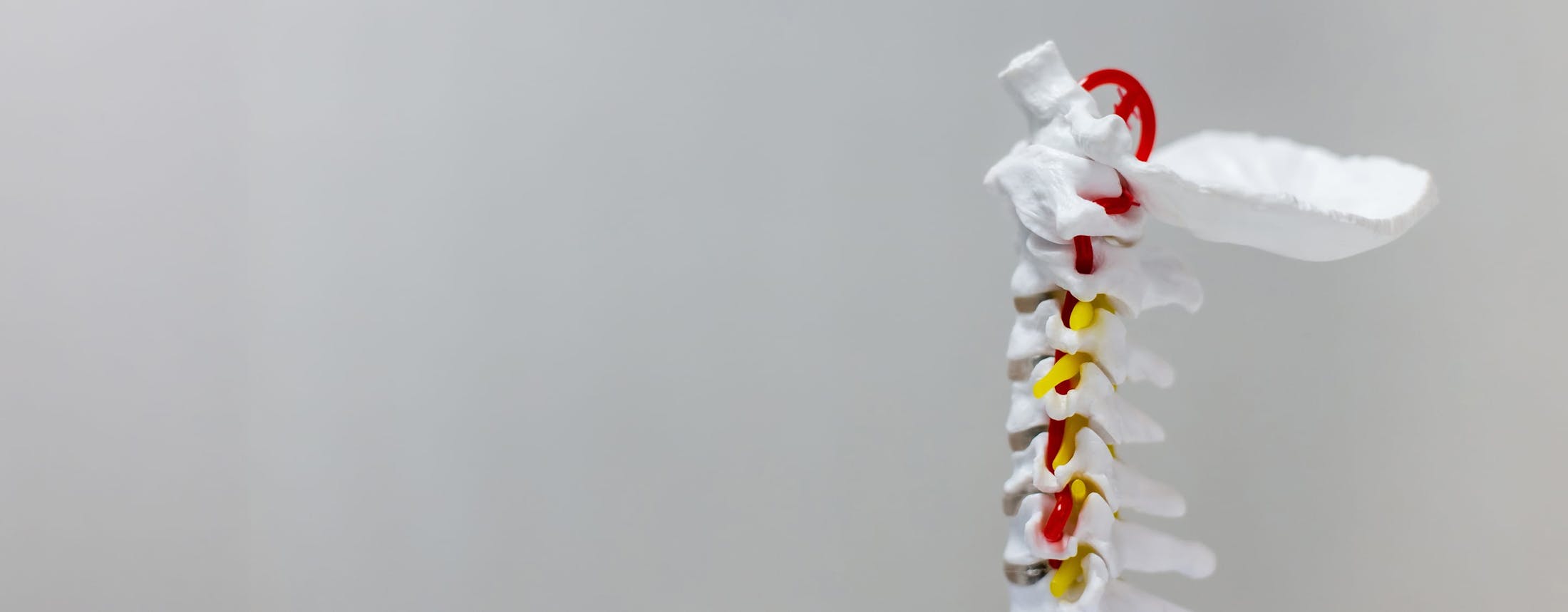
Cervical disc arthroplasty, the clinical term for artificial disc replacement, addresses damaged or degenerated cervical discs by removing them entirely and seating a prosthetic implant in their place. The implant is engineered to replicate how a healthy disc behaves mechanically: absorbing load, allowing controlled movement, and maintaining the spacing between vertebrae. The treated level keeps functioning as part of a mobile spine rather than becoming a fixed, immovable segment.

The Case for Motion Preservation

Every cervical fusion creates a biomechanical ripple effect. The levels immediately neighboring a fused segment must compensate for its lost motion, taking on stress they were not designed to absorb indefinitely. Research has documented the result: accelerated degeneration at adjacent levels over time, sometimes requiring additional surgery years down the line. Disc replacement sidesteps this problem by keeping the treated level functional, preserving a more natural load distribution across the cervical spine and potentially protecting neighboring levels from premature wear.

A Decision That Deserves Individual Consideration

Disc replacement is not the right answer for every patient or every cervical condition, and presenting it as such would not serve patients well. At our Bayonne location, every surgical candidate is evaluated individually. Disc replacement, fusion, and all other relevant options are presented honestly, with a clear explanation of the evidence behind each, so the final decision reflects both clinical reality and the patient's own goals and priorities.

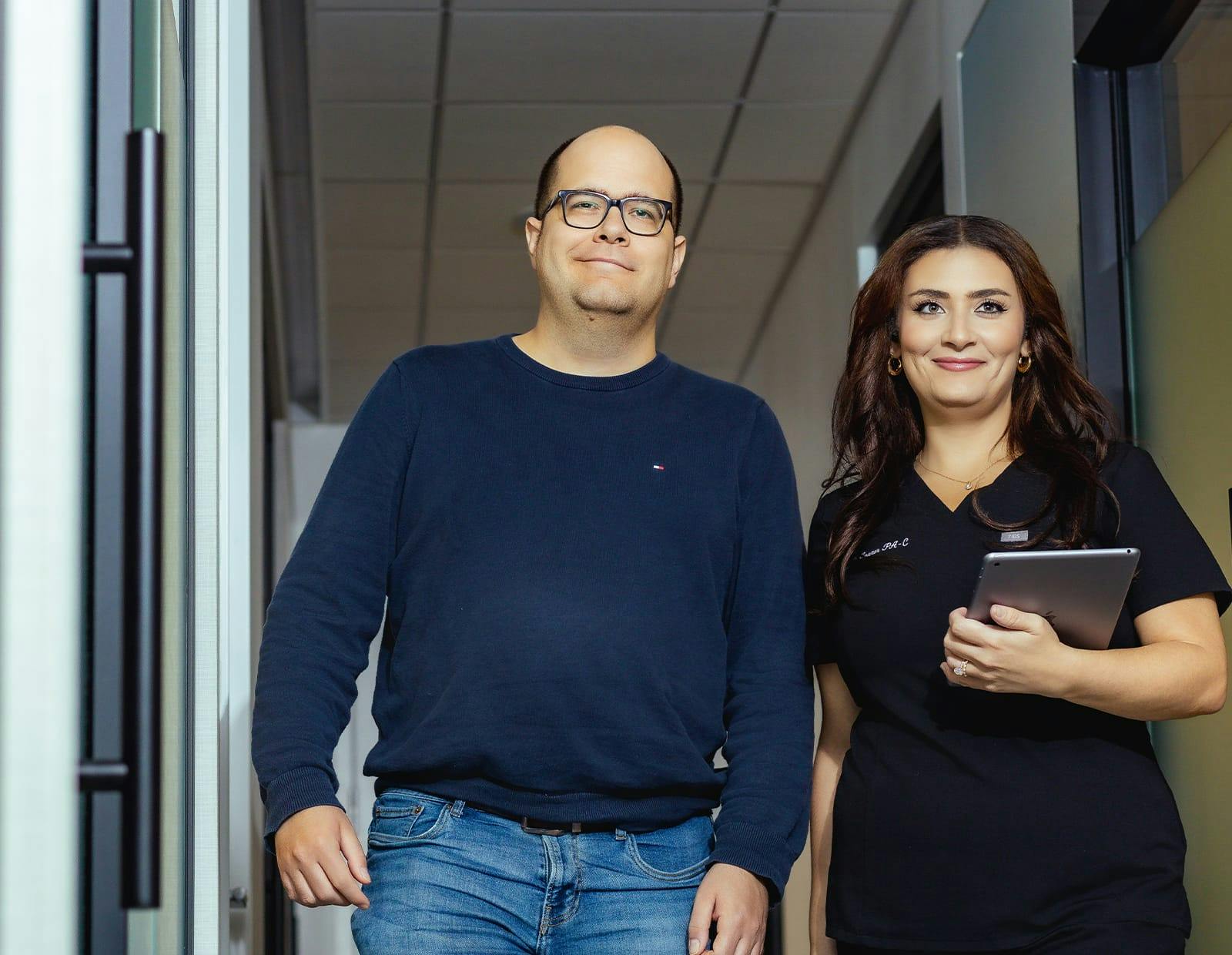
A medical professional walking in a hallway with a male patient

Conditions Treated With Artificial Cervical Disc Replacement

Cervical disc replacement is considered when a structurally compromised disc is compressing the spinal cord or a nerve root, producing symptoms significant enough to warrant surgical intervention after conservative treatment has been exhausted. Appropriate presentations include:

  • Cervical disc herniation with radiculopathy producing arm pain, numbness, or tingling
  • Cervical myelopathy from single or two-level disc compression
  • Cervical degenerative disc disease with nerve involvement
  • Discogenic neck pain at one or two levels in appropriate candidates

Disc Replacement Versus Fusion: Understanding the Difference

Both procedures treat cervical disc disease effectively, but they are not interchangeable. The right choice depends on the patient's anatomy, age, activity level, and the specific characteristics of their condition.

Artificial Disc Replacement

Disc replacement tends to be most appropriate for younger, more active patients with one or two affected cervical levels, intact facet joints, adequate bone quality, and no significant spinal instability. Recovery is generally faster and less restrictive than fusion, and the long-term biomechanical advantages of motion preservation are most relevant for patients with many active years ahead of them.

Fusion (ACDF)

Fusion remains the preferred approach when significant spinal instability is present, when facet joint degeneration is advanced, when the pathology spans multiple levels, or when anatomy makes disc replacement technically unsuitable. It carries a longer clinical track record and is appropriate for a wider range of anatomical presentations.

Our Bayonne team will review your imaging carefully and walk you through which approach fits your specific situation and why.

Background media

Are You a Candidate for Artificial Cervical Disc Replacement in Bayonne?

The profile that best suits disc replacement is a younger to middle-aged adult, generally between 18 and 60, with one or two cervical disc levels causing symptoms, healthy facet joints at those levels, sufficient bone density to support the implant, and a conservative treatment history that has not delivered adequate relief.

On the other side of the ledger, significant facet joint arthritis, prior surgery at the affected level, osteoporosis, active infection, and certain implant material sensitivities all shift the balance toward fusion as the more appropriate choice. Determining which category a patient falls into requires a detailed clinical evaluation and imaging review, which is exactly how our Bayonne team approaches every surgical consultation.

medical equipment

We’re here to help you move forward.

Contact Us

What to Expect From Artificial Cervical Disc Replacement in Bayonne

Before Your Procedure

Before any decision is made, your surgeon will conduct a thorough review of your symptom history, imaging findings, and everything you have already tried. All surgical options—disc replacement, fusion, and any other relevant approaches—are presented with equal transparency, along with the reasoning behind each. You will leave the consultation with a clear understanding of what is being recommended and why.

The Day of Your Procedure

The procedure is performed under general anesthesia through a small incision at the front of the neck. The damaged disc is removed, and the prosthetic implant is precisely positioned and seated within the disc space. Most patients are discharged the same day or within 24 hours of the procedure.

Recovery After Your Procedure

Recovery from cervical disc replacement is generally faster and less restrictive than fusion recovery, with most patients returning to light activity within a week and resuming normal routines within three to six weeks. Because there is no fusion to wait for, activity restrictions are less prolonged. Our Bayonne team provides detailed post-operative guidance and monitors your progress closely throughout recovery.

Doctor media

Why Choose Gerling Spine Care and Research Institute?

Offering motion-preserving cervical surgery requires more than technical access to the implant. It requires clinical judgment to know when it is genuinely the right choice, the honesty to recommend fusion when it is not, and the surgical depth to execute either procedure at the highest level. With more than 300 peer-reviewed publications, active leadership in NASS, CSRS, and LSRS, and decades of focused cervical spine experience, our Bayonne team brings all of that to every patient who walks through the door.

Artificial Cervical Disc Replacement Freaquently Asked Questions

How does disc replacement differ from ACDF?

The primary difference is what happens to the treated spinal level after surgery. ACDF removes the damaged disc and permanently fuses the surrounding vertebrae with a bone graft and plate, eliminating motion at that level. Disc replacement removes the damaged disc and replaces it with an artificial implant that preserves motion. Both procedures effectively relieve nerve or spinal cord compression, and the most appropriate option depends on your anatomy, age, activity level, and the condition of the surrounding spine.

How long will an artificial disc implant last?

Artificial cervical disc implants are designed for long-term durability, and multi-year clinical studies have shown encouraging results. Because disc replacement is newer than fusion, very long-term data is still being collected. Your surgeon will discuss current evidence and realistic expectations during your consultation.

What if I turn out not to be a candidate for disc replacement?

If disc replacement is not appropriate, there are several other effective treatment options. Depending on your condition, these may include ACDF, cervical laminoplasty, or other decompression procedures. Your surgeon will review all suitable alternatives and help you choose the approach that best fits your needs.

Can disc replacement be performed at more than one level?

Yes. Two-level disc replacement is well supported by clinical evidence in appropriately selected patients. Disc replacement at three or more adjacent levels is generally not recommended. Your surgeon will evaluate your imaging and anatomy to determine whether you are a candidate for multilevel treatment.

What does recovery feel like after disc replacement?

Mild neck soreness and stiffness are common during the first several days after surgery. Most patients find recovery more comfortable and less restrictive than expected, particularly because there is no need to wait for a spinal fusion to heal. Pain is typically managed with oral medication, and many patients return to light activities within the first week.

We're here to help you move forward.

Relief starts with quality orthopedic care. Contact us today to take the next step toward a more active, pain-free life.

Schedule Appointment (opens in a new tab)
Contact us media
Accessibility: If you are vision-impaired or have some other impairment covered by the Americans with Disabilities Act or a similar law, and you wish to discuss potential accommodations related to using this website, please contact our Accessibility Manager at 201-201-7246.
Contact Us