Keep Moving: A Smarter Approach to Cervical Disc Disease

For patients dealing with cervical disc disease, surgery has long meant fusion — and with it, a permanent loss of neck mobility. Artificial Cervical Disc Replacement offers a different path. At Gerling Spine Care and Research Institute, our Queens patients have access to this advanced, motion-preserving alternative, performed by a surgical team at the forefront of minimally invasive spine care.

Contact our Queens office today to find out if Artificial Cervical Disc Replacement is right for you.

What Is Artificial Cervical Disc Replacement?

Artificial Cervical Disc Replacement (also called cervical disc arthroplasty) is a surgical procedure in which a damaged or degenerated cervical disc is removed and replaced with a prosthetic implant designed to mimic the movement of a healthy disc.

Preserving Motion, Protecting Your Spine

Unlike fusion procedures such as ACDF, which permanently join two vertebrae together, disc replacement preserves motion at the treated spinal level. Maintaining natural cervical movement not only improves quality of life, but may also reduce the risk of adjacent segment degeneration — a condition in which the spinal levels above and below a fusion site experience accelerated wear over time.

A Personalized Approach

At Gerling Spine Care and Research Institute, we view disc replacement as one important tool within a broader philosophy of motion-preserving spine care. Not every patient is a candidate, and we take care to match each individual with the approach best suited to their anatomy, lifestyle, and long-term goals.

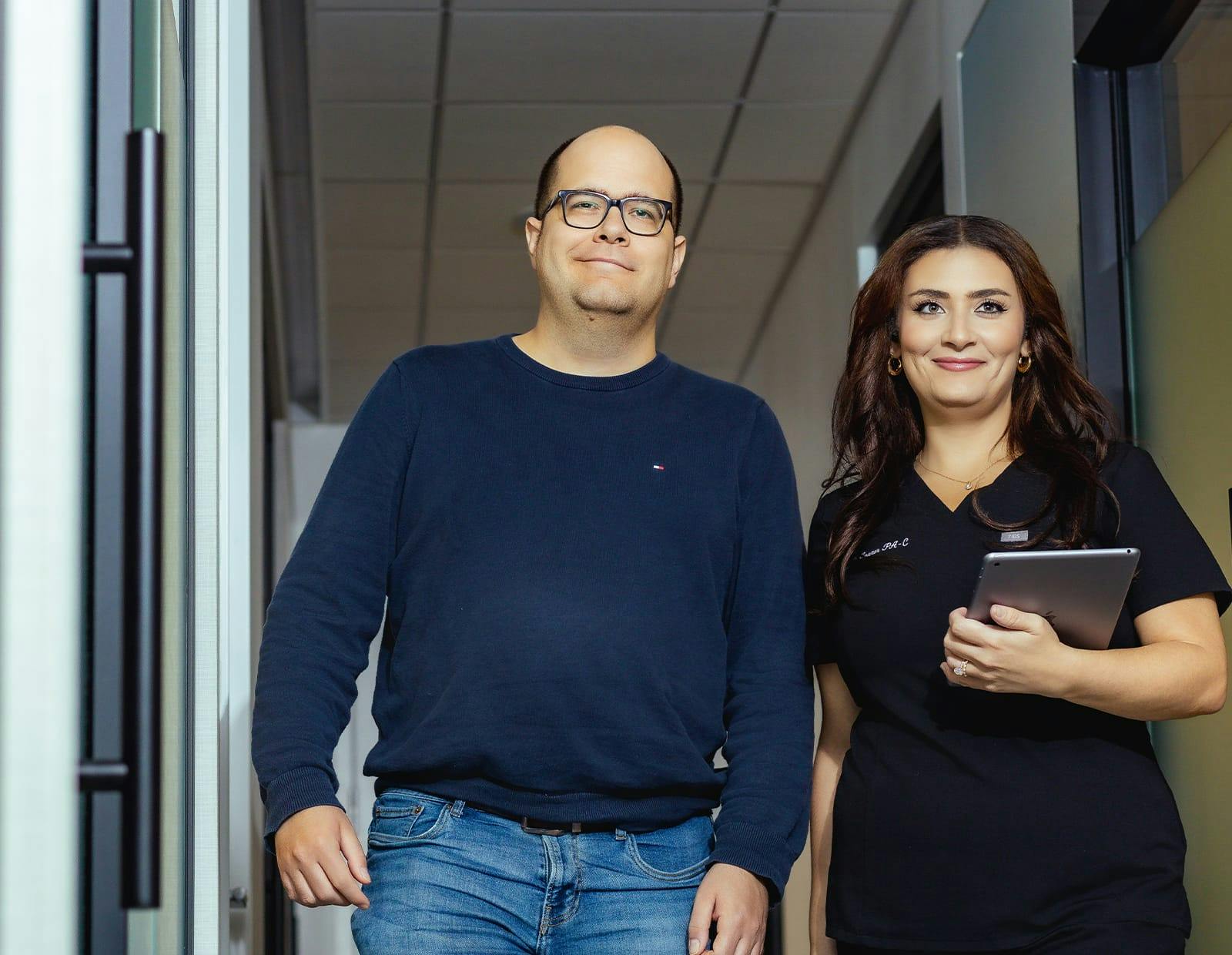
A medical professional walking in a hallway with a male patient

Conditions Treated With Artificial Cervical Disc Replacement

Cervical disc replacement is used to treat conditions in which a damaged disc is compressing the spinal cord or nearby nerve roots. Common indications include:

  • Herniated cervical disc
  • Cervical degenerative disc disease
  • Cervical radiculopathy (pinched nerve causing arm pain, numbness, or tingling)
  • Cervical myelopathy (spinal cord compression)

The procedure is typically considered after conservative treatments — including physical therapy, medication, and injections — have failed to provide adequate relief over a sustained period.


Disc Replacement vs. Fusion: Understanding Your Options

Both Artificial Cervical Disc Replacement and ACDF are effective treatments for cervical disc disease, but they serve different patient profiles. Understanding the distinction helps you and your surgeon make the right decision together.

Artificial Disc Replacement

Disc replacement preserves motion at the treated level, allows for a faster and less restrictive recovery, and may reduce the long-term risk of adjacent segment disease. It is generally best suited for younger, active patients with one or two affected disc levels and no significant facet joint disease.

Fusion (ACDF)

Fusion permanently stabilizes the affected segment, making it the preferred option in cases involving more complex pathology, multiple levels, or significant bony instability. It has a long and well-documented track record of success.

Our Queens surgeons are experienced in both approaches and will provide an honest, thorough evaluation to determine which is most appropriate for your specific situation.

Background media

Are You a Candidate for Artificial Cervical Disc Replacement in Queens?

Not all patients are suitable candidates for cervical disc replacement. In general, good candidates tend to be adults in good overall health, typically between the ages of 18 and 60, with one or two diseased cervical discs and symptoms that have not responded to conservative care. Disc replacement may not be appropriate for patients with advanced spinal degeneration, significant facet joint disease, osteoporosis, active infection, or allergy to implant materials. Three or more adjacent affected levels is also typically a contraindication. A thorough consultation with our team — including a review of your imaging and medical history — is the only reliable way to determine candidacy.

sitting area

What to Expect Your Disc Replacement Journey

The process from consultation to recovery is designed to keep you informed, supported, and on the fastest possible path back to your normal life.

Before Surgery

Your consultation will include a detailed review of your symptoms, imaging, and prior treatments. Our surgeons take the time to walk through all available options, answer your questions thoroughly, and ensure you feel confident in whatever path forward you choose.

The Day of Surgery

The procedure is performed under general anesthesia through a small incision at the front of the neck. The damaged disc is removed and the artificial implant is precisely positioned in the disc space. Most patients are discharged the same day or within 24 hours.

Recovery

Recovery from cervical disc replacement is generally faster and less restrictive than recovery from fusion. Most patients can return to light activity within one week and resume normal routines within three to six weeks. Our team provides comprehensive post-operative care and remains closely involved throughout your recovery.

Doctor media

Why Choose Gerling Spine Care and Research Institute?

Gerling Spine Care and Research Institute offers Queens patients a rare combination: surgical excellence, a research-driven clinical culture, and a genuine commitment to preserving function wherever possible. With over 300 peer-reviewed publications and leadership roles in major national spine societies, our team brings academic rigor to every patient interaction. We are dedicated to finding the right solution for each patient, not the most convenient one.

Artificial Cervical Disc Replacement Frequently Asked Questions

How is disc replacement different from ACDF?

ACDF fuses two vertebrae permanently, while disc replacement preserves motion at the treated level. Both are effective; the right choice depends on your specific anatomy, the number of affected levels, and your lifestyle goals.

Will the artificial disc last forever?

Artificial disc implants are designed for long-term durability, but because the procedure is newer than fusion, very long-term data is still being collected. Your surgeon will discuss realistic expectations during your consultation.

Is the surgery performed from the front or the back of the neck?

Like ACDF, cervical disc replacement is performed through an anterior (front) approach, using a small incision at the front of the neck to access the spine without disturbing the spinal cord or back muscles.

What happens if disc replacement is not right for me?

If you are not a candidate for disc replacement, there are other effective options, including ACDF, cervical laminoplasty, or other motion-preserving approaches. Our Queens team will present all viable alternatives and help you make an informed decision.

Can I have disc replacement at more than one level?

Disc replacement can be performed at one or two adjacent cervical levels in appropriate candidates. Replacement at three or more adjacent levels is generally not recommended. Your surgeon will assess your imaging to determine what is feasible.

We're here to help you move forward.

Relief starts with quality orthopedic care. Contact us today to take the next step toward a more active, pain-free life.

Schedule Appointment (opens in a new tab)
Contact us media
Accessibility: If you are vision-impaired or have some other impairment covered by the Americans with Disabilities Act or a similar law, and you wish to discuss potential accommodations related to using this website, please contact our Accessibility Manager at 201-201-7246.
Contact Us